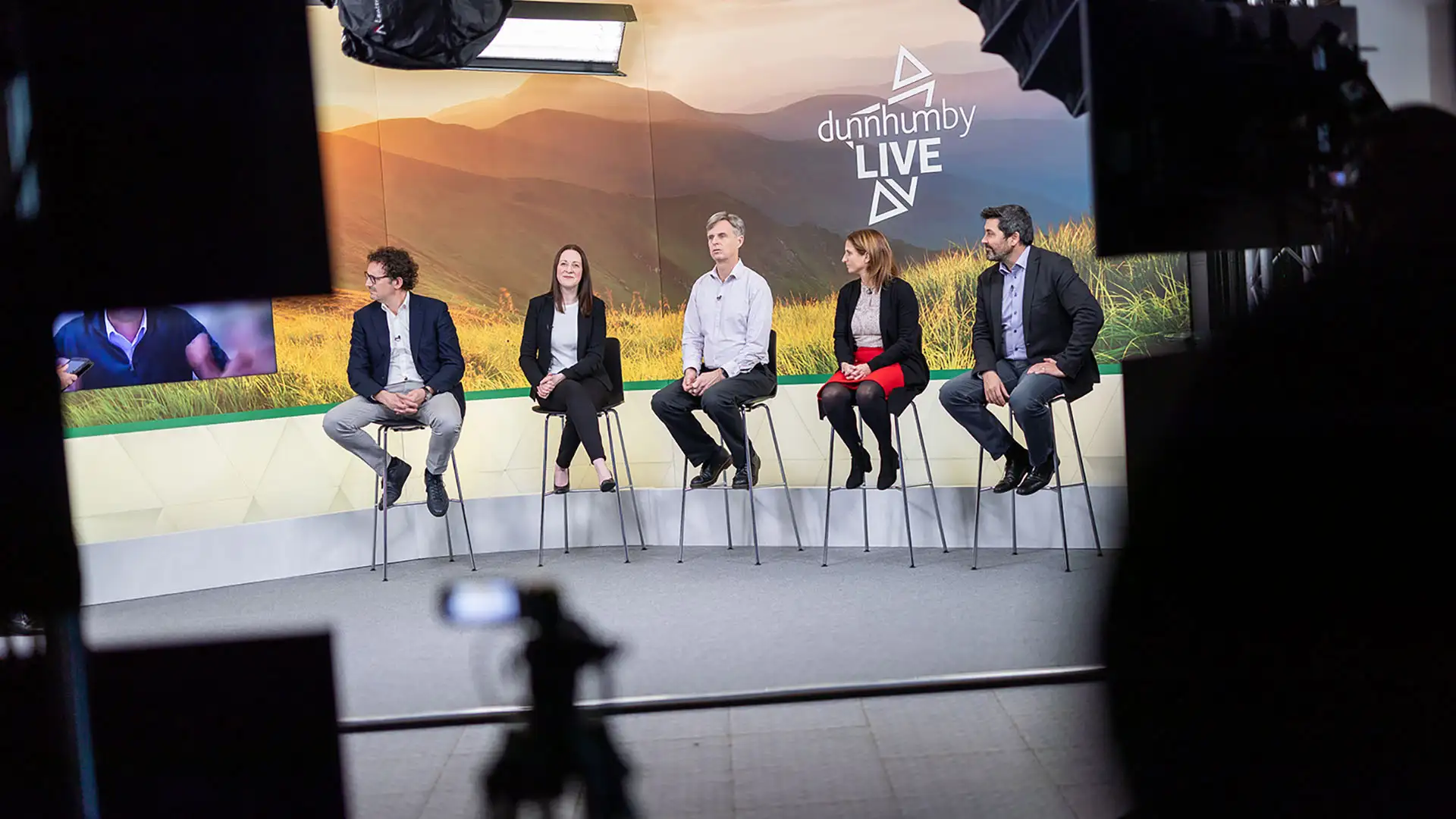
How to design a hybrid company kick off
Hybrid is not “a livestream from the main event”. It is two events running on the same content, and they need to be designed differently.
The post-event review meeting is short. The in-room audience said the kick off was great. The food, the production, the energy in the room: all of it landed. The remote audience, on the other hand, opened the link, watched for about twenty-five minutes, and then quietly closed the tab. The chat was empty by lunchtime. The dial-in numbers looked fine in the dashboard. Engagement looked nothing like fine. Leadership has said “include everyone” again for next year. You need a different approach.
This article is for the person designing the next one. It treats hybrid as a design problem, not a production problem. Production decisions follow from it, but they do not solve it. The first thing that has to change is the way the event is scoped before anyone has picked a camera.
Direct answer
A hybrid company kick off is two events running on the same content. The strongest hybrid kick offs design for the remote audience first (dedicated hosting, shorter blocks, multi-camera production and an interactive layer) and then layer the in-person room on top. Treat the livestream as an afterthought and the remote half will disengage within half an hour, regardless of how strong the day looks from the stage.
Key Takeaways - At a glance
- Hybrid is a design problem, not a production problem. The fix begins in the scope, not the AV plan.
- The remote audience experiences a completely different event from the in-person room, even when watching the same content.
- The strongest hybrid kick offs design for remote first: shorter blocks, dedicated remote host, multi-camera production, explicit cross-audience callouts from leadership.
- Hybrid typically adds 40 to 80% to the production line, or roughly a quarter to a third to total event cost. The full breakdown is in our cost article.
- Excluding remote attendees from the design signals where they sit in the hierarchy. Most organisations cannot afford that signal in a hybrid era.
Why most hybrid kick offs fail
The failure modes are predictable, which is the good news. Four patterns appear in nearly every hybrid kick off post-mortem.
- Livestream-as-broadcast. A camera is pointed at the main room. The remote audience watches the stage from one angle, hears the in-room audience laugh at jokes they cannot see, and feels, accurately, like they are watching someone else’s event. The production team has done its job. The design team has not done theirs.
- In-room-only Q&A. Someone in the audience asks a great question. The CEO answers it. The remote audience hears the answer and not the question, because the questioner did not have a microphone. By the third time this happens, the chat has gone quiet, the questions stop coming, and the remote audience is no longer asking what they could not hear because they have stopped expecting to be heard.
- No remote host. The dedicated person whose job is the remote audience does not exist. The CEO occasionally remembers to say hello to the people watching at home. No one is managing chat in real time. No one is moderating the breakouts. No one is signalling to the production gallery when the remote energy is dropping. The remote audience becomes leaderless and drifts.
- Content blocks too long. The agenda was designed for an in-person event. Fifteen-minute talks become thirty-minute talks because the room can hold thirty minutes. The remote audience, on a laptop in a home office, cannot. Microsoft’s 2025 Work Trend Index reports that employees say they start to zone out in 52% of meetings within the first thirty minutes. That number is the design constraint hybrid kick offs are working against, and most agendas do not respect it.
Each of these is fixable. They are also predictable. A hybrid kick off design that does not address them at the structural level will repeat them.
What is the “two-room problem”?
The two-room problem is the design principle that organises everything else. The remote and in-person audiences experience completely different events even when they are watching the same content. The in-person audience has the energy of the room, peer reactions, body language from the stage, a meal they ate together, and a sense of being there. The remote audience has a screen, a chat box, and a domestic environment competing for attention.
This is not a production gap. It is an experience gap. No amount of additional camera angles closes it on its own. The structural answer is to stop treating hybrid as one event with a livestream attached and start treating it as two events running on the same content.
The scale of this problem is not small. UK ONS data shows around a quarter of workers in Great Britain were hybrid workers in 2025, with another 13% working fully remotely. For most UK organisations with a knowledge workforce, “remote” is not a minority audience. It is a meaningful proportion of the people the kick off needs to land with, and in some sectors it is a majority.
The implication is uncomfortable but useful. If the remote audience matters strategically, the kick off has to be designed with them as a first-class room, not as the secondary viewing audience of someone else’s day.
How should you design a hybrid company kick off?
The principle that follows from the two-room problem is this: design for the remote audience first, then layer the in-person experience on top. The in-person room can carry itself. The remote room cannot.
In practice, that means three structural shifts.
- Shorter content blocks. Fifteen to eighteen minutes maximum for any single speaker or content section. Long blocks are the single most common reason remote audiences disengage. The in-person room can hold a thirty-minute talk because the room itself holds attention. The remote audience cannot. If a block needs to be longer, break it into segments with a deliberate transition between them.
- Two-host model. One host in the room. One host with the remote audience. Both visible from the start, both with explicit roles, both addressed by leadership during the day. The remote host is not a stage manager. They are the voice of the remote room, with the licence to interrupt, ask questions on behalf of the chat, and signal when remote energy needs attention.
- Explicit cross-audience callouts from leadership. The CEO addresses both rooms by name throughout the day. “For those of you in the room, and for those of you joining us from across the country, this is what I want to land today”. This is a small linguistic shift with a large signalling effect. It tells the remote audience that they are not the secondary room. It also keeps the in-person speakers honest, because they cannot drift into delivery that only works for the room in front of them.
These three shifts are the difference between a hybrid kick off and a livestream from a kick off.
What production setup does a hybrid kick off actually need?
The production architecture follows from the design, not the other way around. The honest specification for a hybrid kick off above about 200 attendees includes the following.
Multi-camera production. At least three cameras, and often four. A wide for the stage, a tight for the speaker, a wide for the audience (so the remote room can see the room), and an angle to cut to for variation. Single-camera production is the giveaway sign that the event has been scoped as in-person with a livestream attached.
Dedicated audio engineering for the remote feed. The remote audience’s experience of audio is different from the in-room experience. The in-room PA system is designed for the space; the remote feed needs a clean, balanced, broadcast-quality mix. This is a separate audio path, run by a separate engineer, monitored continuously through the day.
Production gallery. A small control room (in-venue or virtual) where the camera switching, graphics, lower thirds, audio mix and chat moderation happen in real time. This is where the production team holds the experience together. MGN delivers most of its hybrid kick offs from its in-house production gallery at its Windsor offices, which is one of the reasons the production layer can adapt quickly during the day.
A streaming platform built for the audience size. Not a generic webinar platform. Not a YouTube unlisted link. A platform with reliable streaming, full chat moderation, polling, breakout rooms, recording for catch-up and analytics for engagement. The choice depends on audience size and security requirements.
On-screen graphics designed for laptop screens. Lower thirds, agenda markers, audience prompts, polling overlays, all designed for the small-screen viewer, not the big-screen room. This is the most underrated production decision and the one that most signals whether the event was designed remote-first.
The investment is real. Hybrid production typically adds 40 to 80% to the AV and production line, or roughly a quarter to a third to total event cost. The fuller cost breakdown sits in our cost article. The investment is also defensible: it is the cost of treating a meaningful proportion of your workforce as a first-class audience rather than an afterthought.
The single biggest hybrid mistake is treating remote as the smaller audience. It is the audience most at risk of disengaging, which makes it the audience the event has to be designed around.
Neil Walker, Production Director, MGN Events
How do you keep remote attendees engaged across the day?
Engagement, at a hybrid kick off, is mostly designed before the day. The choices that hold remote attention come from the structure, not from gimmicks. There are, however, a small number of in-day mechanics that work.
Polling that informs the next block. Real-time polls (with the results visible to everyone, in-room and online) that shape what leadership says next. The poll is not decoration. It is a moment where the remote audience changes the day.
Chat moderation by name. The remote host reads questions from chat with the questioner’s name, the team they sit in, and where they are joining from. The remote audience starts seeing their colleagues participate. The participation rate climbs because participation has become visible.
Breakouts with remote facilitators. Where the agenda includes breakouts, the remote breakouts need their own facilitators (not the same person running an in-room breakout on a tablet). A real conversation happens because there is someone whose job is to make it happen.
Deliberate “your turn” moments. Two or three points in the day where the remote audience is explicitly asked to do something: type a reflection, vote, share a comment, raise a virtual hand. The cadence matters. Without it, the remote audience drifts into passive viewing within thirty minutes.
The mechanics to avoid are the ones that signal fake interactivity. Generic word clouds that nobody reads. Polls whose results are never referenced. “Hello from…” chats that go on for three minutes and then vanish. These add the appearance of engagement without the substance, and the remote audience reads the difference quickly.
How much more does a hybrid kick off cost?
The rule of thumb in MGN’s experience is that hybrid adds 40 to 80% to the production line, or roughly 25 to 40% to total event cost, depending on audience size and the depth of the hybrid layer. A hybrid kick off for 500 attendees with a meaningful remote audience is materially more expensive than an in-person-only version of the same event.
The investment goes into multi-camera production, dedicated remote audio engineering, a streaming platform, an additional host, an engagement layer, and graphics designed for small-screen viewing. The line items are visible. So is the value: the remote half of the workforce experiences the event as participants rather than spectators.
The fuller cost breakdown, by audience size and by line item, lives in our piece on what a company kick off costs in 2026.
Bringing it together
The hybrid layer is the part of a company kick off most likely to be under-designed and over-budgeted. The discipline that gets the most out of the spend is structural: design for the remote audience first, layer the in-person room on top, and build the production architecture from the design.
MGN delivers hybrid kick offs from its in-house production base in Windsor, with multi-camera production, dedicated remote hosting, audio engineering, streaming platform selection, polling and breakout infrastructure all run by one team. Our in-house warehouse and gallery give us direct control over quality and the flexibility to adapt during the day. If you are scoping a hybrid kick off and want a clear view of what the production architecture actually takes, we would be glad to walk through it.
Call 01932 22 33 33 or email hello@mgnevents.co.uk.
You can also explore our Company Kick Offs page.
Hybrid company Kick Off FAQs
DO WE NEED A SEPARATE REMOTE HOST?
Yes for events above about 200 attendees, or where more than 30% of the audience is remote. The remote host is the single most underrated production decision in hybrid kick offs. Below that scale, the in-room host can sometimes carry both audiences if the remote share is small.
HOW LONG SHOULD HYBRID KICK OFF BLOCKS BE?
Fifteen to eighteen minutes maximum, with deliberate breaks between them. Remote attendees disengage faster than in-room audiences regardless of content quality, because the environment is competing for their attention. A long block that works in the room does not transfer.
SHOULD WE RECORD THE KICK OFF FOR CATCH-UP?
Yes. A produced, edited highlights cut is more valuable than a raw recording, both for absent employees and for use during the 90 days after the event. Plan for it during the run-of-show, not as a post-event afterthought. The edited cut can be a meaningful part of the post-event reinforcement system, covered in our follow-through article.
IS FULLY-VIRTUAL EVER BETTER THAN HYBRID?
For geographically dispersed workforces with no anchor location, sometimes yes. A fully-virtual kick off can be deliberately designed for a single audience rather than two, which removes the two-room problem. It can also be materially cheaper. MGN’s virtual events service page covers this in more depth.
HOW DO WE DEAL WITH MULTIPLE TIME ZONES?
Two options work. The first is to compress the live event to a window most time zones can join, and rely on a same-day on-demand release for the rest. The second is to run two live deliveries on the same day for different regional audiences, with the CEO appearing in both. The second option costs more but signals real respect for the global audience.
Written by MGN Events, a UK creative events agency specialising in corporate events and brand experiences.

Neil Walker,
Production Director
Known for his logic, love of a good process, and occasional obsession with Google Sheets, he’s the one people turn to when something breaks, stops, or just needs fixing fast.


