Why Most B2B Product Launches Are Forgotten
The room claps politely. The sales team posts a short message in Slack. A handful of customers reply to the launch email. Then, within a week, the conversation moves on. Three months later, nobody on a customer call references the product the way the launch promised they would. The launch happened. The product is in market. The memory of the moment has already gone.
This article is the strategic counterpart to the full launch event playbook. Where the playbook covers the system, this piece tackles the design problem at its centre: most B2B launches are designed for completeness, not memorability. That is fixable. It is not a budget question.
Direct Answer
Most B2B product launches are forgotten because they’re designed for completeness, covering every feature, addressing every audience, fitting every stakeholder concern, rather than for memorability. Memory research, including Kahneman’s peak-end rule, shows that attendees remember a launch by its single most intense moment and how it ended, not by what it covered. Anchored launches survive smaller budgets. Forgettable launches aren’t rescued by larger ones.
At a glance
- Memorability is a design discipline, not a budget question.
- Kahneman’s peak-end rule: attendees remember the peak and the end, not the middle.
- Anchored memorability beats comprehensive coverage every time.
- Five design moves build memorability: anchored reveal, narrative spine, sensory specificity, signature element, post-event reinforcement.
- Forgettable launches and weak pipeline impact are the same problem in different language.
The "forgotten by Monday" pattern
You can usually tell within forty-eight hours. The internal recap deck lands. The Slack channel goes quiet. The sales floor gets one round of talking points and then defaults back to the old pitch. Customers who attended send brief thank-yous, not questions. Marketing reports attendance, NPS, and a few quotes pulled from a feedback form. The launch is logged as a success because nobody is calling it a failure.
That is the pattern. Polite applause, weak follow-up, no anchored reference point three months later. The launch is in the past tense almost immediately. It hasn’t entered the way the room talks about the company.
The reason this pattern is so common is that it isn’t anyone’s fault inside the project. The deck was thorough. The room was full. The food was good. The product team got to present what they built. The executive sponsor was happy. Every box on the brief was ticked. And yet the moment didn’t stick.
“A launch that everyone agrees went well, but nobody references three months later, is a launch that did its operational job and failed its commercial one.”,
Mike Walker, Managing Director, MGN Events
The diagnostic question is unforgiving. If a salesperson, in a competitive deal twelve weeks from now, can’t reach for one specific image, one phrase, one staging moment from the launch and use it to anchor a customer conversation, the launch is a sunk cost. It happened. It didn’t land. The rest of this article explains why, and what to do about it.
Why do most B2B product launches fade so fast?
The behavioural answer is that most launches are designed to cover, not to anchor.
The brief reads something like this. Cover the three product pillars. Address sales, marketing, customer success and partners. Include the executive narrative, the customer proof, the roadmap and the technical detail. Make sure analysts have the briefing pack. Make sure the demo is comprehensive. The result is a competent, dense, evenly weighted ninety minutes that gives every internal stakeholder what they asked for. It also gives the room nothing to hold onto.
This is the completeness trap. The launch is treated as a content delivery exercise. Every minute earns its place by transmitting information. The implicit assumption is that the more the room is told, the more the room will remember. Memory doesn’t work that way. Attention doesn’t work that way. The room remembers texture, not coverage.
Forrester’s research on B2B “moments of trust” makes the commercial cost concrete. Trust in B2B is built and broken in a small number of high-stakes moments, not across an evenly distributed surface of touchpoints. A launch is one of those moments. If it lands as competent and forgettable, the company has used one of its scarce trust-building moments to confirm that it can run a competent, forgettable event. That is not a neutral outcome. It is a missed lever.
Most well-run brand and marketing events the company runs in a given year are operating against this same constraint. There are only so many moments where the audience is fully present. Designing those moments for completeness rather than memorability is the most common, and most expensive, mistake in the category.
What the peak-end rule tells us about launch design
Behavioural science has a useful explanation for why complete launches are forgettable launches. Daniel Kahneman, in Thinking, Fast and Slow, describes the peak-end rule. When people remember an experience, they don’t average it. They store two data points: the most intense moment of the experience, and how it ended. Everything else fades. The middle, no matter how long or how dense, gets compressed into a single vague impression.
Apply this to the standard B2B launch. The peak is usually under-designed. The reveal is a slide change. The product appears on a screen. The CEO says the name. The audience nods. The end is usually under-designed too. The agenda runs to time. People applaud. Drinks are in the foyer. There is no moment that closes the story.
The middle, by contrast, is heavily over-designed. Three speakers, a demo, a customer video, a roadmap, a partner segment, a Q&A. The brief gave the middle most of the budget, most of the rehearsal time, and most of the project manager’s attention. The middle is what the room experiences. The middle is also what the room will forget.
The implication is uncomfortable, and worth stating directly. Most B2B launches spend most of their resource on the part of the event that contributes least to memory. The peak and the end, which are doing almost all of the work in the audience’s recall, are often the last things designed and the first things compromised when time runs short.
“Most B2B launches spend most of their budget on the part of the event the audience is least likely to remember.”,
Mike Walker, Managing Director, MGN Events
The fix is not to make the middle worse. It is to design the peak and the end with the same intent and the same craft as any other commercial moment in the company’s calendar.
What makes a product launch memorable?
Three things, working together. Sensory specificity. Narrative coherence. An anchored signature element that the room can re-tell to someone who wasn’t there.
The Heath brothers’ SUCCESs framework, from Made to Stick, captures most of this in shorthand. Sticky ideas tend to be Simple, Unexpected, Concrete, Credible, Emotional, and Stories. The framework isn’t a checklist. It is a description of what tends to be true of ideas that survive being passed on. Launches that stick share most of these properties. Launches that don’t, usually fail on Concrete and Unexpected first. They are abstract where they should be specific, and predictable where they should surprise.
Sensory specificity is the most under-used of these. The room remembers what it could see, hear, touch and feel. A product unveiled on a rotating plinth with one specific piece of music, in one specific lighting state, with one specific physical gesture, is concrete in a way a slide reveal can never be. The salesperson re-telling that moment to a customer three months later has something to describe. The customer who attended has something to describe to a colleague. The detail becomes the carrier of the message.
Narrative coherence is the second. The launch should feel like one argument, not a series of segments. Every section should advance the same idea. The room should be able to summarise the launch in a sentence afterwards, and that sentence should be the sentence the company wanted them to leave with.
The signature element is the third. A phrase, an image, a gesture, a sound. Something the room can reach for. Something that gets re-used in the post-event content because it was designed to be re-usable. Without it, the launch leaves no fingerprint.
The five design moves that make a launch stick
These are the moves that translate the behavioural research into a brief. They aren’t a format. They are design constraints that can be applied across keynote, demo, immersive room, broadcast or hybrid.
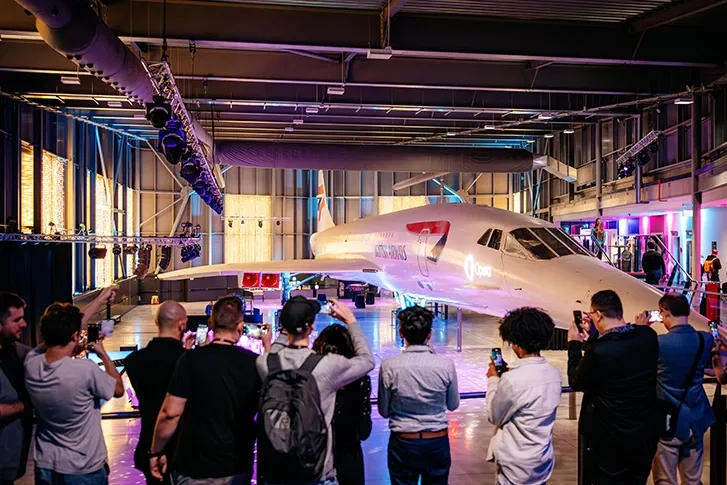
1. Anchored reveal moment. One image, one staging move, one sensory element that the room can’t unsee. Designed deliberately, not improvised. The product doesn’t appear because the slide changed. It appears because the lighting, the sound, the staging and the physical reveal were built to make that moment the peak of the event. Everything else in the room is paced around protecting it. If the reveal is doing its job, the question “what was the moment?” has one obvious answer.
2. Narrative spine. One story running through every touchpoint. Pre-launch teasers, the reveal, the demo, the customer proof, the close. Not a tagline. A through-line. Each section should make the same argument from a different angle. The audience should leave able to re-tell the story, not just list the features. MGN’s theatre-trained creative direction designs anchored launch moments by treating the narrative spine as the first design decision, not the last copy pass.
3. Sensory specificity. A specific object, sound, smell, lighting state, gesture. Concrete details outperform abstract messages every time. “Faster” is forgettable. The sound of a specific bell at the moment the product is named is not. The brief should specify the senses involved, not just the words spoken. This is where most B2B launches default to safety. Safety is the enemy of memory.
4. Signature element. Something repeatable. A phrase, an image, a gesture, a piece of music. Something that gets re-used in post-launch content because it was designed to be re-usable. The signature is what allows the launch to live beyond the day. It is what the sales team reaches for in week six. It is what marketing builds the campaign around in week ten. Without a signature, post-launch content is a series of recap posts that nobody re-shares.
5. Post-event reinforcement cadence. Scheduled touchpoints that reactivate the memory at intervals. Week one, week four, week twelve. Memory needs reactivation to survive. A launch that fires once and goes silent is a launch that fades on schedule. Reinforcement isn’t a “nice to have.” It is the difference between a launch that lasts a week and a launch that is still being referenced in customer conversations at the end of the quarter. See our article on launch formats that build anchored moments, for how this applies across different formats.
Take any one of these out and the launch weakens. Take two or more out, which is the norm, and the launch fades by Monday.
Why bigger budgets don't rescue forgettable design
This is the part most project sponsors find hardest to accept. A larger budget applied to the same wrong design produces the same forgettable result, only more expensively.
Doubling the production spend on a launch that lacks an anchored peak doesn’t create one. It produces a more polished version of the middle. The lighting is better. The video walls are bigger. The catering is more interesting. The audience still leaves with no specific moment to retell. The post-event recap is glossier, and equally short-lived.
Conversely, a launch on a modest budget with a clearly designed peak, a coherent spine, a sensory detail the room can describe, a re-usable signature and a planned reinforcement cadence outperforms a launch at double the spend without those things. The cost of memorability is not financial. It is the willingness to design constraints into the brief and protect them through the project, even when the natural drift is towards covering more ground.
“Anchored design at half the budget outperforms comprehensive design at double. The difference is in the brief, not the cheque.”,
Matthew Strange, Creative Director, MGN Events
There is a related, harder truth. Big-budget launches are often the most likely to drift into completeness. The more money in the room, the more stakeholders feel entitled to a segment in the agenda. The agenda balloons. The peak and the end get compressed. The launch ends up more comprehensive, more expensive and less memorable than its smaller predecessor. Budget without design discipline buys forgettability at scale.
How does memorability link to commercial outcomes?
Memorability is not a soft metric. It is the mechanism by which a launch does commercial work over the months that follow.
The test is simple. Twelve weeks after the launch, can a salesperson reference a specific moment from the event in a live customer conversation in a way that advances the deal? If yes, the launch is working as a pipeline asset. The investment is compounding. If no, the launch has reverted to being a one-off expense.
This is why the apparent split between “brand work” and “pipeline work” is misleading when applied to launches. A memorable launch is brand and pipeline at the same time. The sensory detail, the signature phrase, the staged reveal become tools that salespeople use to compress complex conversations. The launch turns into shorthand. The shorthand turns into faster, cleaner deals. See how memorability translates into pipeline impact, for the measurement model.
Forgettable launches and weak pipeline impact are the same problem stated in different languages. The marketing function calls it “low recall.” The sales function calls it “the launch didn’t really help.” The CFO calls it “no measurable revenue effect.” All three are describing the same design failure: the launch had no peak, no signature, and no reinforcement cadence.
The corollary is also true. A launch that scores well on these design moves tends to be the launch that, six months on, marketing is still cutting content from, sales is still referencing in pitches, and the executive team is still treating as the company’s story for the year. The same event, designed differently, becomes a recurring commercial asset rather than a one-off line item.

How to brief for memorability without specifying the format
The most useful brief for a memorable launch is clear on outcome and open on solution. It tells the creative team what the room should remember. It does not tell the creative team how to make the room remember it.
Two questions, asked early and answered honestly, do most of the work.
First. What should the room remember in twelve weeks? Not the product name. The product name is a given. What is the one image, sentence or moment that should be in the room’s recall when the launch is referenced? If the brief can’t answer this, the launch will default to completeness and forget itself.
Second. What should the salesperson be able to reach for in a customer conversation? A specific phrase. A specific image. A specific demo moment. A specific story. The brief should name it. The creative team should then design backwards from it.
What the brief shouldn’t do is pre-specify the format. “We want a keynote with a panel” is a format brief. It locks the design in before the memorability question has been answered. The better brief states the outcomes and trusts the creative team to choose the format that delivers them. Sometimes that is a keynote. Sometimes it is an immersive room with no stage at all. Sometimes it is a small, sharply designed broadcast moment that lives online. The format follows the memorability target, not the other way around. Read our article writing a brief that prioritises memorability, for the full brief template.
This single shift, from format-led brief to memorability-led brief, is the most underused unlock in the category. It costs nothing. It changes everything that follows.
Talk to a specialist
The pattern is consistent across hundreds of B2B launches. The ones that last are the ones that were designed to last. Anchored peak. Coherent spine. Specific sensory detail. Re-usable signature. Reinforcement cadence. Five disciplines, applied early in the brief, before format and budget are set. Everything else is operational competence around the edges of those five decisions. Memorable launches are designed. Forgettable ones are organised. For a fuller picture of where launches sit within the broader category, see brand experiences and the Product Launch Playbook.
Talk to MGN Events about designing a launch that lasts longer than a week. Call 01932 22 33 33 or email hello@mgnevents.co.uk. Or download the Product Launch Playbook for the integrated launch framework.
Why product launches Fail: FAQs
How do you measure whether a launch was memorable?
Three practical tests. Twelve weeks post-launch, ask five salespeople to describe the launch in one sentence without preparation. If three of them reach for the same image, phrase or moment, the launch has an anchor. Second, count how many post-event content pieces use the launch's signature element naturally rather than as a tagged reference. Third, listen for unprompted launch references in customer-facing calls. NPS and attendance numbers measure the day. These three measure the memory.
Does memorability mean the launch needs to be flashy?
No. Memorability is about specificity, not spectacle. A single, deliberately designed sensory detail at the peak moment will outperform expensive production with no anchor. Some of the most memorable launches in the category are visually restrained and tightly designed around one idea. Spectacle without anchoring is forgettable spectacle.
How long should a launch's "peak moment" actually last?
Short. Often under sixty seconds. The peak is the moment the product is revealed and the room reacts. Stretched peaks dilute. The job of the rest of the launch is to set up that moment and to give it room to land. Designing the peak to be brief and unmistakable is more useful than designing it to be long and elaborate.
Why do bigger launch budgets often produce forgettable launches?
Because larger budgets tend to attract larger stakeholder lists. The agenda fills with segments that protect internal interests rather than serve the audience's memory. The peak and the end get compressed to make room. The launch becomes more comprehensive and less anchored. Budget discipline doesn't fix this. Design discipline does.
Can you make a small launch genuinely memorable?
Yes, and consistently. A modest-budget launch with one anchored reveal, a coherent narrative spine, one sensory detail, one signature element and a planned three-touch reinforcement cadence will outperform a far larger launch without those things. Memorability is a design property, not a budget property.
Written by MGN Events, a UK creative events agency specialising in corporate events and brand experiences, with in-house production, theatre-trained creative direction and almost 20 years delivering live moments for brands.

Mike Walker,
Managing Director
Mike is Managing Director at MGN Events and has spent the last 20+ years helping companies and private clients bring ambitious events to life. From global conferences and all-company festivals to once-in-a-lifetime milestone parties, he’s passionate about combining bold ideas with seamless delivery. Colleagues and clients know Mike for his big-picture thinking and relentless drive…he’s loud on the phone, louder with ideas and never short of a one-liner to keep things fun!
Connect with Mike on LinkedIn


